Massé family apartment on Rue d’Hauteville
Chanson douceThe Massé family apartment on Rue d’Hauteville is both the setting of Louise’s daily work as a nanny and the crime scene at the center of the novel’s final investigation. Its rooms hold the routines through which Louise becomes familiar to the children, while the kitchen’s domestic details acquire a darker significance after the killings. The apartment returns at the end not as a recovered home but as a preserved stage on which Nina Dorval attempts to understand what happened.
Home and Workplace
At 7:30 one morning, Louise opens the apartment door and Mila, dressed in blue pajamas, runs to her and jumps into her arms. Mila’s delighted recognition—“Louise, it’s you! You’re back!”—makes the apartment a place of reunion as well as employment: the children’s attachment is expressed through the threshold and the welcome it allows. Adam, held by Myriam, struggles toward Louise after recognizing her voice, the talc scent, and the light sound of her step on the parquet. Myriam smiles and offers him to Louise’s embrace. In these small gestures, the home’s caregiving relationships are made visible through bodily familiarity and repeated contact.
The apartment also reveals the careful, sometimes almost minute management of food and domestic labor. Myriam’s refrigerator contains small stacked containers and bowls under aluminum foil, alongside scraps: a piece of lemon, a wilted bit of cucumber, a quarter of an onion, and the rind of a piece of cheese. There are only a few peas, three pieces of pasta, a spoonful of purée, and a wisp of turkey, which Louise has nevertheless taken care to store. The inventory gives the kitchen the scale of the household’s everyday economy: even remnants are kept, sorted, and made part of the work of feeding the children.
The Kitchen and the Chicken Carcass
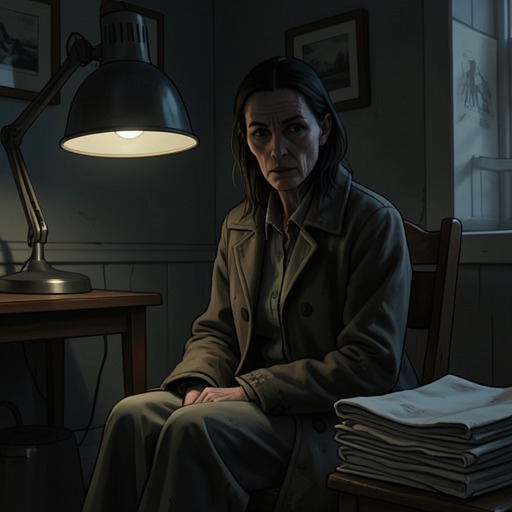
On another evening, Myriam comes into the kitchen expecting a moment alone with a cold glass of white wine and a cigarette. Instead, she finds the room unusually immaculate. Soap hangs in the air; the refrigerator door has been cleaned; the counter is clear; the extractor hood and cupboard handles have been wiped; and the window gleams. The extraordinary cleanliness makes the room feel less reassuring than strange, as though ordinary signs of use have been deliberately erased.
At the center of the small table where the children and their nanny eat sits a chicken carcass on a plate. No meat remains on it. Myriam sees its smooth spine, pointed bones, twisted wings, and glistening yellow cartilage; through the holes of the rib cage, the interior appears empty and black. Though nothing remains to rot, the carcass strikes her as a corpse still decaying in her kitchen. The domestic table, normally associated with meals and care, has become the display place for an unsettling object. The contrast between the scrubbed room and the stripped skeleton makes the apartment’s familiar kitchen newly threatening.
Crime Scene and Reconstruction
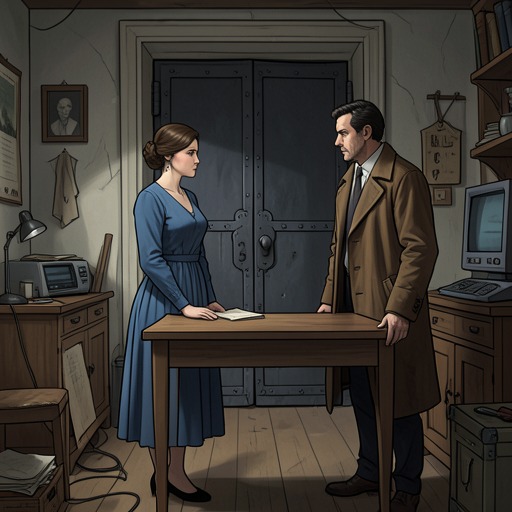
After the killings, the apartment is sealed. Nina Dorval learns that the seals will be removed at 7:30 the following morning—the hour Louise used to arrive—and that a reconstruction will take place there. Nina has notified the judge, prosecutor, and lawyers, and insists that she will play the nanny. She knows the case intimately: she was the first investigator to reach the scene after Rose Grinberg’s call reporting that the nanny had killed the children.
The building’s entrance has become a public spectacle. When Nina arrives, an ambulance has just left with Mila, while onlookers gather in the street, drawn by the sirens and the rushing emergency response. One man photographs the entrance; Nina has him removed. Inside the stairwell, she meets rescuers carrying Myriam out. Louise remains upstairs, unconscious, with a small white ceramic knife in her hand. Nina orders that she be taken out through the back door. These details fix the apartment as the setting of both private catastrophe and public exposure, where the family’s home is abruptly entered by emergency workers, police, and spectators.
An Unchanged Interior
The reconstruction is planned for the apartment as it stood on the day of the crime in May. No one has returned to collect belongings or even retrieve papers. Outside, bouquets and children’s drawings are still fading; inside, the rooms remain available for Nina’s attempt to retrace Louise’s movements. She expects the exercise to reveal a detail or make a contradiction intelligible, and imagines entering past candles and taking the elevator before knocking three times at the apartment door.
In the reconstruction, Nina will let herself experience the apartment as a sequence of burdensome household spaces: the washing machine, the perpetually dirty sink, toys spilling from their boxes and gathering under tables. She imagines becoming Louise as she moves repeatedly between bedroom and kitchen, bathroom and kitchen, rubbish bin and dryer, bed and entrance cupboard, balcony and bathroom. The investigator’s imagined route turns the apartment’s layout into an account of repetitive labor. It ends with Louise taking a knife from a cupboard and drinking a glass of wine by the open window, one foot on the small balcony, before calling the children to take a bath. The apartment’s ordinary rooms and objects therefore frame the transformation of caregiving routine into violence, while the reconstruction’s return to the unchanged scene shows how the home has become inseparable from the unanswered crime.